

Revenue Cycle Management in Healthcare (RCM)
Our intensive course on Revenue Cycle Management (RCM) provides the focused expertise you need to master every crucial stage of the revenue lifecycle.
This program goes far beyond surface-level concepts, diving deep into the technical processes essential for financial health.
Why Choose This Course?
Why Choose This RCM Course?

Real-World Setup Simulation
Move beyond passive learning with our exclusive real-world setup simulations. You won't just learn theory; you will actively work through scenarios, setting up and managing a simulated revenue cycle. This hands-on experience ensures you are job-ready and confident in tackling financial challenges from day one.

Comprehensive 16-Step Mastery
Gain a complete, structured understanding of the entire revenue lifecycle by mastering the 16 distinct steps of RCM in Healthcare. We cover the entire process, from patient pre-registration and scheduling all the way through denial management and final reporting, ensuring no critical step is missed.

Free Professional Certification
Upon successful completion, you will receive a free PDF Certificate. This professional acknowledgment validates your expertise in RCM, enhancing your resume and demonstrating your commitment to financial excellence in healthcare.

Key Achievements
Upon completing this course, you will be able to
Upon completing this course, you will be able to:
Master the End-to-End RCM Process: Understand and manage all key stages of the healthcare revenue cycle, from patient access to final payment.
Optimize Front-End Operations: Confidently execute pre-registration and insurance verification to ensure data accuracy and timely billing.
Ensure Accurate Reimbursement: Gain proficiency in medical coding, charge entry, and claims submission to guarantee prompt and correct payments.
Strengthen Financial Health: Develop critical skills in accounts receivable management and denial resolution, significantly improving cash flow and reducing outstanding balances.
Apply Best Practices: Implement industry standards to streamline billing, minimize errors, and contribute directly to the financial sustainability of any healthcare organization.
Course overview
This comprehensive course offers in-depth, practical knowledge of the entire Revenue Cycle Management (RCM) process, essential for maximizing revenue flow and ensuring the financial stability of any healthcare organization.
You will gain proficiency in all 16 critical steps, transforming you from a novice to an expert in healthcare financial administration.
This program systematically guides you through the five core modules of RCM:
1: Introduction to RCM
This foundational module establishes a comprehensive understanding of Revenue Cycle Management (RCM) in Healthcare and its vital role in financial health. You'll explore the 16 systematic steps that define the RCM process and gain the essential foundational knowledge required to become a certified expert in managing complex healthcare financial flows
2: Pre-Registration and Insurance Verification
Master the critical front-end processes of RCM, beginning with Pre-Registration. You'll learn the roles, requirements, and benefits of efficient Patient Onboarding. Crucially, you will master the Insurance Verification Process and various methods to ensure accurate patient data, which is key to preventing claim issues and securing timely payments.
3: Medical Coding, Charge Entry, and Claim Submission
Dive into the technical core by exploring Medical Coding Standards and their direct impact on reimbursement. Gain expertise in the Charge Entry Process and the meticulous steps required for a Clean Claim Submission. Finally, understand the procedures for tracking claim status and feedback post-submission to ensure efficiency.
4: Accounts Receivable (AR) and AR Follow-Up
This module focuses on managing outstanding balances. Understand the Importance of AR in RCM and key metrics like the AR Benchmark. You will learn the best practices for managing accounts receivable, including strategies for Reducing Days in AR and utilizing automation to effectively overcome common collection challenges.
5: Denial Management and Reporting
Learn to significantly improve reimbursement rates by identifying the Types of Denials and mastering the robust Denial Management Process. The module concludes by exploring the Roles and Metrics of Reporting in RCM, teaching you how to use data-driven feedback for the continuous strategic improvement of the entire revenue cycle.
Course Features and Benefits
- Provides hands-on experience by letting you practice setting up and managing a simulated revenue cycle, ensuring you are job-ready.
- Offers a structured deep dive into all 16 critical stages of RCM, guaranteeing complete systematic process understanding.
- Gain the skills to identify financial bottlenecks, leading directly to maximized collections and revenue.
- Master advanced denial management strategies to significantly improve claim acceptance rates and minimize costly rejections.
- Learn best practices in Accounts Receivable (AR) management and follow-up, ensuring quicker payments and reduced outstanding balances.
- Achieve proficiency in pre-registration and insurance verification to ensure data accuracy, which is crucial for clean claim submissions.
- Develop expertise in medical coding standards and charge entry, boosting the overall accuracy of your billing practices.
- Understand key RCM metrics and reporting roles, enabling you to use data for continuous process improvement.
- Access detailed Handouts for ongoing reference and the option to Order Transcripts for formal record-keeping of your professional learning.
- Receive a complimentary PDF Certificate upon completion, providing verifiable proof of your expertise for career enhancement.
Accreditation: CPDQE Certified RCM Training
This course holds official accreditation from CPDQE (Continuing Professional Development Qualification Endorsement).
In today's competitive environment, CPD is essential for skill enhancement, maintaining credential relevance, and career advancement. This CPDQE Certified Course ensures you receive the required, recognized professional training necessary to meet your development goals.

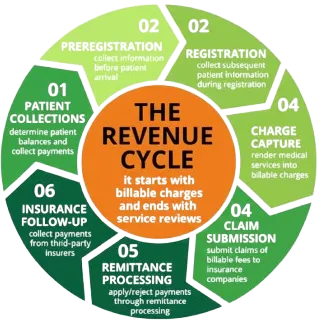
RCM involves all steps from patient registration, insurance verification, charge capture, coding, claims submission, payment posting, and follow-up on denials, with the goal of ensuring maximum, timely reimbursement for services rendered.
- Segment Your Customers: Understand and categorize your patient/payer mix.
- Understand Value: Determine the perceived value of your services to payers and patients.
- Predict Demand: Forecast patient volume and service needs.
- Optimize Pricing: Set appropriate charges based on market, costs, and contracts.
- Control Inventory/Availability: Strategically manage appointment slots and resource capacity.
- Use Metrics: Continuously monitor performance using key indicators (KPIs).
- Optimize Distribution/Delivery: Streamline service delivery and claims submission channels.
- Front-End Process (Patient Access): This includes everything that happens before or during service delivery, such as patient registration, scheduling, and insurance verification. Its goal is to collect accurate demographic and financial data to ensure a clean claim is submitted later.
- Mid-Cycle Process (Clinical/Documentation): This involves charge capture, clinical documentation, and medical coding. Its goal is to accurately translate services rendered into billable codes.
- Back-End Process (Financial): This includes claims submission, remittance processing (payment posting), accounts receivable (AR) follow-up, and denial management. Its goal is to maximize collections and minimize outstanding balances.
- Improved Financial Health: Maximizing revenue collection and minimizing lost income.
- Enhanced Operational Efficiency: Streamlining billing processes and reducing administrative time.
- Reduced Claim Denials: Ensuring clean claims are submitted the first time.
- Better Compliance: Maintaining accurate records and adherence to payer guidelines and regulations.
- Superior Patient Experience: Facilitating accurate and clear billing, reducing patient confusion and friction.
Common RCM KPIs include:
- Days in Accounts Receivable (AR): The average time it takes to get paid after a service is rendered (lower is better).
- Clean Claims Rate: The percentage of claims submitted without errors that are paid upon the first submission (higher is better).
- Net Collection Rate: The percentage of collectible revenue actually collected.
- Denial Rate: The percentage of claims rejected by payers.
It is typically broken down into 16 steps, which cover the entire financial and administrative journey of a patient visit:
- Pre-Registration/Scheduling
- Insurance Eligibility & Verification
- Patient Check-In
- Charge Capture
- Clinical Documentation
- Medical Coding
- Claim Generation
- Claims Submission
- Payer Adjudication
- Payment Posting
- Accounts Receivable Follow-Up
- Denial Management
- Patient Billing
- Collections
- Reporting & Analytics
- Contract Management


Reviews From Our Students
Fluently exchange personal information, discuss family, relationships, and identity, and accurately use fingerspelling for names and places.

Trusted by Leading Platforms
Our excellent ratings across multiple platforms reflect our commitment to quality education and student success

